

| Quick answer: If someone dies without a will in Alabama, their probate assets are distributed under Alabama’s intestate succession laws. The probate court appoints a personal representative to pay debts, handle the estate, and distribute the remaining assets to the deceased’s legal heirs. Because these rules can lead to unexpected outcomes and disputes, many families work with a probate lawyer to navigate the process correctly and avoid unnecessary delays or complications. |
When someone dies without a will in Alabama, their estate is distributed under Alabama intestate succession laws. Instead of family members deciding how assets should be divided, the probate court follows a legal order of inheritance set by state law.
While this framework applies in every intestate estate, it does not account for personal wishes, family dynamics, or unique financial situations. These gaps are often where disputes, delays, and confusion arise during probate, which is why many families ultimately turn to an intestate succession lawyer in Alabama at Southern Estate Lawyers for guidance.
This article is for informational purposes only and does not constitute legal advice.
How Alabama Intestate Succession Works
When a person dies without a valid will in Alabama, to distribute their assets to the heirs at law, an estate must be opened in the Probate Court. This process is referred to as Probate. During this process, the court applies Alabama’s intestacy laws to determine who inherits. The outcome depends largely on your surviving relatives.
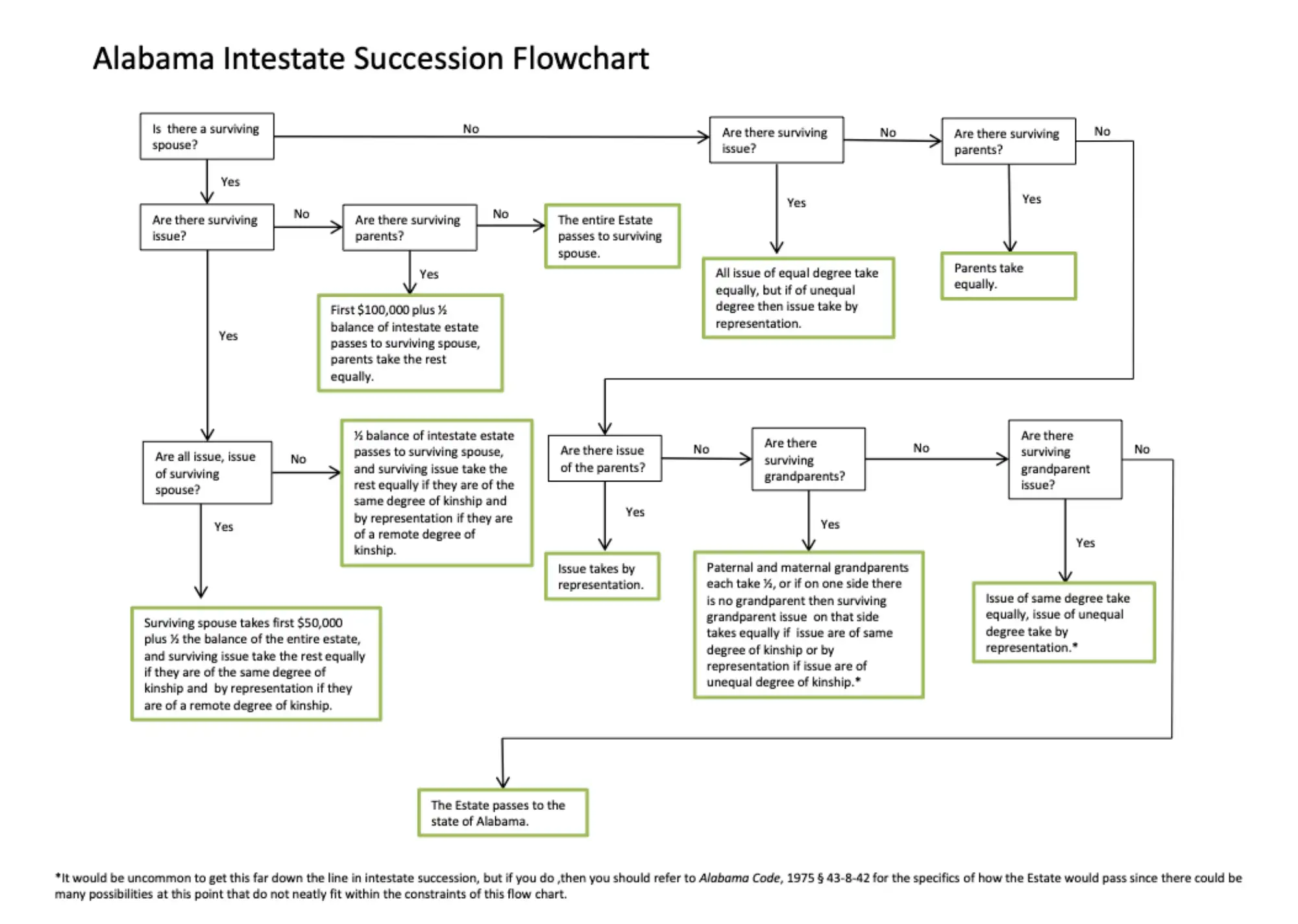
Instead of following personal wishes, the court uses a legal hierarchy of heirs established under Alabama law. In most cases, inheritance is determined in the following general order:
- Spouse
- Children
- Parents
- Siblings
- More distant relatives
The distribution can change depending on whether the deceased had children from a prior relationship, whether parents are still living, or whether there is a surviving spouse. In other words, the law creates a formula, but that formula may not match what the individual would have chosen.
Who Inherits if There is No Will Under Alabama Intestate Succession Laws?
Intestate succession in Alabama often surprises families because the outcome depends on specific family dynamics. For example:
- If you are married with children from that marriage, your spouse and children typically share the estate
- If you are married and have children from a prior relationship, the division may look very different
- If you are unmarried with no children, your parents or siblings may inherit
- If no close relatives survive, more distant relatives may receive the estate
Stepchildren, unmarried partners, close friends, and charities generally do not inherit under intestate succession laws unless specifically provided for in a will. This is one of the most common sources of confusion and disappointment for families.
Because every family situation is different, these rules do not always apply as straightforwardly as they appear. During a free consultation, one of our attorneys can review your specific circumstances, explain how Alabama law applies to your case, and help you understand what to expect moving forward.
Click the image below to view a detailed flowchart showing how Alabama intestate succession determines who inherits an estate.
Common Issues We See in the Alabama Intestate Succession Cases We Handle
When families come to Southern Estate Lawyers after a loved one dies without a will, they are often caught off guard by how assets are divided.
Some of the most common issues we see include:
- A surviving spouse does not automatically inherit the entire estate under Alabama intestacy rules
- Children may inherit assets outright at age 19, which is the age of majority in Alabama, regardless of financial maturity or family expectations
- Blended families may experience unintended outcomes, especially when children are from prior relationships
- Unmarried partners and long-term companions are not recognized as legal heirs under Alabama intestate succession law
- Stepchildren generally do not inherit unless they were legally adopted
- Probate administration may take longer because there are no instructions in a valid will to guide the process
These situations are not rare. These are issues our lawyers regularly encounter in probate and estate litigation matters. As a result, intestate succession cases in Alabama often require careful legal guidance to ensure the estate is properly administered and heirs are correctly identified.

Why Intestacy Can Lead to Disputes
Intestate succession laws are structured and rigid. They do not account for family tensions, unequal contributions, estrangement, or verbal promises. Without a will:
- There is no named executor chosen by the deceased
- Family members may disagree about who should manage the estate
- Asset distribution may feel unfair to certain relatives
- Disputes over personal property can escalate quickly
While probate courts provide structure, they cannot resolve emotional disagreements that often arise when expectations differ from legal outcomes. Careful planning during life is often the best way to minimize these risks.
At Southern Estate Lawyers, our role goes beyond handling disputes after they arise. We help families address potential sources of conflict early and take proactive steps to reduce the risk of costly probate litigation whenever possible.
★★★★★
“Thank you. Your professionalism and determination made all the difference in my Estate and Trust Litigation matter. You exceeded my greatest expectations and have added significantly to my family’s future. I am grateful for your sincere concern.” – Keith P.
Protecting Your Wishes With an Alabama Estate Plan
While intestate succession law provides a default structure during probate, it does not account for personal relationships, blended families, or specific intentions. Working with an Alabama estate planning lawyer allows you to take control of these decisions in advance and reduce the impact of intestate probate on your family.
A properly designed estate plan can help you:
- Decide exactly who inherits your property and assets
- Appoint a trusted personal representative (executor) for your estate
- Plan for minor children through guardianship and structured inheritance provisions
- Reduce the risk of disputes or probate litigation among heirs
- Provide clear legal instructions that guide your family and the probate court
Thoughtful planning today can help your family avoid unnecessary uncertainty during Alabama probate in the future.
How Southern Estate Lawyers Can Help
At Southern Estate Lawyers, we assist families across Alabama with every stage of intestate probate, from opening the estate to final distribution. We help clients by:
- Opening and managing probate proceedings in Alabama probate court
- Identifying legal heirs and confirming inheritance rights under intestate succession rules
- Collecting, securing, and organizing estate assets and financial records
- Handling required filings, deadlines, and court communications
- Addressing disputes that may arise between heirs or beneficiaries
- Resolving contested issues through negotiation or probate litigation when necessary
Because intestate estates must follow a fixed legal framework, accuracy and timing matter at every step. Our attorneys ensure the process is handled correctly so your family can move through probate with fewer delays and fewer avoidable complications.
If your case ultimately leads to litigation, we invite you to review our case results to see the difference experienced courtroom advocacy can make when your family’s inheritance is on the line.
Get Local Probate Guidance Near You in Alabama
While Alabama probate laws apply statewide, each county probate court operates a little differently. Filing procedures, timelines, and documentation requirements can vary depending on where the estate is being administered. Our probate attorneys in Alabama guide families and executors through the probate process with clear, practical support at every stage.
We’re available at several Alabama office locations to provide in-person support when needed:
- Foley: Visit our Foley Office at 901 N McKenzie Street Suite B, Foley, AL 36535. We work with families throughout Baldwin County who need help navigating probate filings, creditor notices, and estate administration.
- Mobile: Our Mobile attorneys are located at 6001 Airport Boulevard, Suite 200A, Mobile, AL 36608. We assist clients across Mobile and the Gulf Coast with the Mobile County Probate Court and help ensure filings are handled correctly and on time.
- Birmingham: Our Birmingham Office is located at 4505 Pine Tree Cir #121, Birmingham, AL 35243, serving Jefferson County and Central Alabama. We help executors and families manage the documentation and court requirements involved in probate administration.
Can’t make it to an office? We offer virtual consultations for families who live outside Alabama or cannot travel. Whether you are in Hoover, Fairhope, or managing an estate from another state, our team can help guide you through the probate process.
Frequently Asked Questions
Read answers to common questions on what happens if someone dies without a will in Alabama.
What is the first step when someone dies without a will in Alabama?
The first step is opening a probate case in the Alabama probate court where the person lived at the time of death. The court will appoint a personal representative to manage the estate, gather assets, and begin the legal process of administration under intestate succession rules.
How long does someone have to file for probate after a death in Alabama?
In Alabama, there is no strict universal deadline to open probate, but delays can create legal and practical problems. Creditors may lose rights over time, assets can become harder to access, and disputes between heirs may increase if the estate is not opened in a timely manner. In most cases, families are encouraged to begin the probate process as soon as reasonably possible after death to avoid complications.
Do all assets go through intestate probate in Alabama?
No. Only probate assets are governed by intestate succession laws. Assets with named beneficiaries, such as life insurance policies, retirement accounts, or jointly owned property, typically pass outside of probate and are not controlled by intestate distribution rules.
How long does probate take in Alabama without a will?
The timeline varies depending on the estate size, creditor claims, and whether any disputes arise between heirs. Some estates may close in several months, while more complex or contested cases can take a year or longer to fully resolve. Watch this video to learn more.
What happens if there are debts in an intestate estate?
Before any inheritance is distributed, the estate must first pay valid debts, taxes, and creditor claims. If there are not enough assets to cover all debts, Alabama probate law determines the order in which creditors are paid.