

| Quick answer: To probate a will in Alabama means to file it with the probate court, have it declared legally valid, and obtain the court’s authority to administer the deceased person’s estate. The process involves appointing an executor, notifying creditors and heirs, inventorying assets, paying debts and taxes, and distributing what remains to beneficiaries. Not every estate requires full probate, but when it does, Alabama law governs each step through the county probate court where the person was a resident. |
When someone you love dies and leaves a will, one of the first questions that comes up is whether you have to go through probate and what that actually involves. Most people have heard the word before, but few know what the process actually looks like, how long it takes, or whether it applies to their situation at all.
While probate is not always complicated, it is a court-supervised legal process with specific rules and deadlines. Understanding the basics before you start can save you significant time and prevent costly mistakes. Our probate attorneys in Alabama can help your family through this process from the first filing through final distribution.
This guide explains what probating a will in Alabama actually means, what the process looks like from start to finish, when probate is and is not required, and what families dealing with this situation right now should know.
What Probating a Will in Alabama Actually Means
Probating a will means filing it with the Alabama probate court and completing the legal process to confirm it is valid, appoint an executor, and administer the estate under court supervision. The court’s role is to verify the will, ensure it meets Alabama’s legal requirements, and authorize the executor to act.
In Alabama, probate is handled under Title 43 in the probate court of the county where the deceased lived. Each county has its own probate court, and most estates move through a largely non-supervised process after the initial filings.
Probate creates a public record of the will, allows creditors to file claims, protects the executor from personal liability when procedures are followed correctly, and ensures assets are distributed under court authority.
While some assets pass outside probate through trusts or beneficiary designations, many estates still require it. When probate is necessary, proper handling is far more important than avoiding it, and most cases take several months to about a year, depending on complexity.
Does Every Will Have to Go Through Probate in Alabama?
No. Whether probate is required depends on what the deceased owned and how those assets were held, not simply on whether they had a will.
Assets that typically pass outside of probate include:
- Property held in joint tenancy with right of survivorship, which passes directly to the surviving owner
- Bank accounts and investment accounts designated as payable-on-death or transfer-on-death
- Life insurance policies with a named beneficiary
- Retirement accounts such as IRAs and 401(k)s with a named beneficiary
- Assets held in a properly funded living trust
If the deceased owned assets solely in their own name without a beneficiary designation or survivorship arrangement, those assets likely need to pass through probate. The will controls how those assets are distributed, but only after the probate process is completed.
Alabama also offers a simplified procedure for small estates. If the total value of the probate estate is $47,000 (subject to change, current as of October 1, 2025) or less (not counting a vehicle), certain heirs may be able to collect assets using a small estate affidavit without opening a full probate proceeding. This option is not available in every situation, and an attorney can help you determine whether it applies.
At Southern Estate Lawyers, one of the most common things we explain to families is that a will does not control every asset. Many assets pass automatically through beneficiary designations, joint ownership, or trusts. Understanding that distinction is often one of the first steps in determining whether probate is necessary at all. A free consultation with our will attorneys in Alabama can bring clarity to your situation.
The Alabama Probate Process: Step by Step
For estates that do require probate, here is how the process unfolds in Alabama from start to finish.
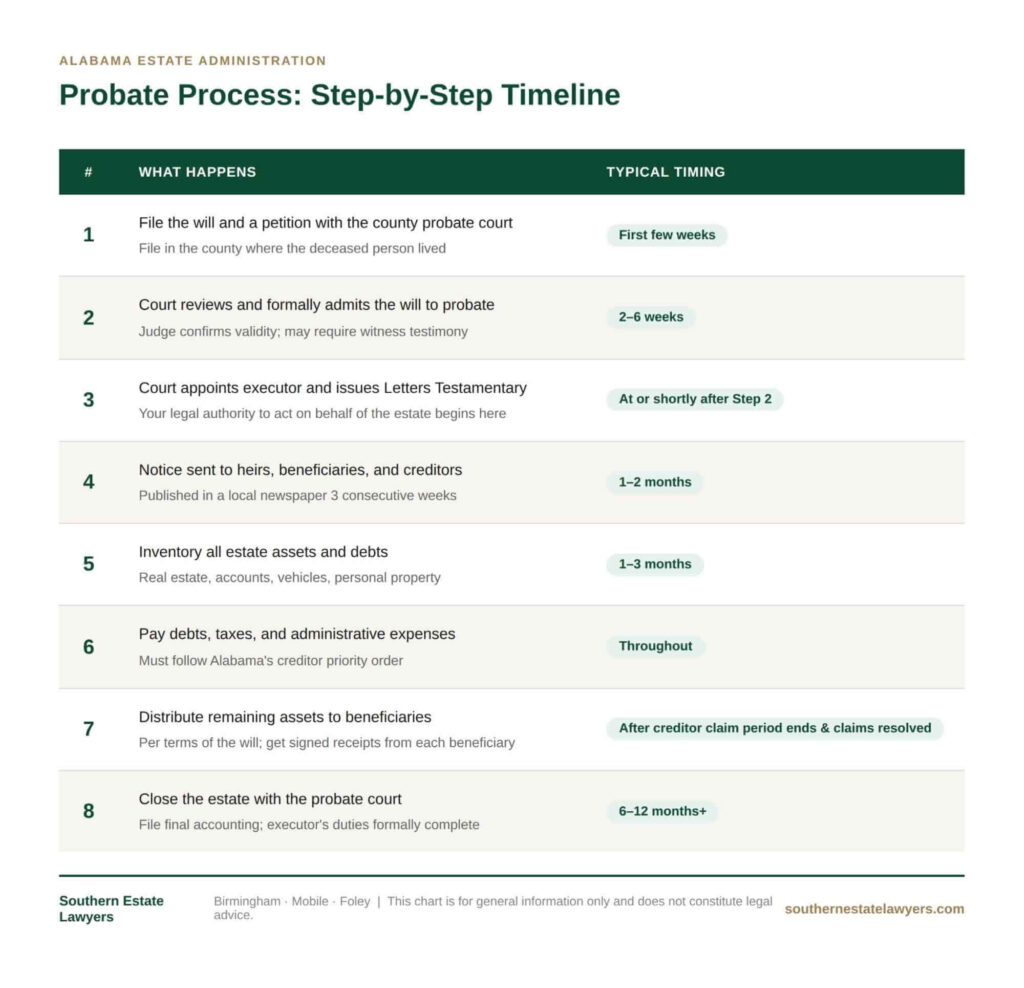
Step 1: File the Will with the Probate Court
The original will must be filed with the probate court in the county where the deceased person lived. Alabama generally requires the original document, not a copy. Along with the will, you file a petition asking the court to admit the will to probate and to appoint the named executor. Filing fees vary by county and are typically based on the estimated value of the estate.
Step 2: The Court Admits the Will to Probate
The probate judge reviews the will to confirm it meets Alabama’s requirements. A valid will must be in writing, signed by the testator (the person making the will), and witnessed by at least two competent witnesses who sign in the testator’s presence. If the will is self-proving, meaning it includes a notarized affidavit from the witnesses, the court can admit it without additional testimony. If not, witness testimony or an affidavit may be required.
Step 3: The Court Appoints the Executor
Once the will is admitted, the court formally appoints the person named as executor, also called a personal representative. If that person is unwilling or unable to serve, the court may appoint an alternate named in the will or a qualified family member. At this point, the court issues Letters Testamentary, which are the official documents authorizing the executor to act on behalf of the estate.
Step 4: Give Notice to Heirs and Creditors
Alabama law requires that notice of the probate proceeding be given to the deceased’s surviving spouse, children, and other heirs, as well as to known creditors. In addition, notice must typically be published in a local newspaper once a week for three consecutive weeks. This gives anyone who might have a claim against the estate, or who might want to contest the will, an opportunity to come forward.
Step 5: Inventory the Estate
The executor is responsible for identifying and valuing all probate assets. This includes real estate, bank accounts, investments, personal property, vehicles, and any other assets owned solely by the deceased. A formal inventory is filed with the probate court. The thoroughness of this step directly affects how smoothly the rest of the process goes.
Step 6: Pay Debts, Taxes, and Administrative Expenses
Before any assets can be distributed to beneficiaries, the estate must pay valid debts, including outstanding bills, mortgages, and creditor claims filed during the notice period. The estate may also owe income taxes for the year of death, and in some larger estates, estate taxes. The executor’s personal liability exposure is greatest during this phase: distributing assets too early, or paying creditors in the wrong order, can create real legal problems.
Step 7: Distribute Assets to Beneficiaries
Once debts and taxes are settled and the creditor claim period has closed, the executor distributes the remaining assets to beneficiaries according to the terms of the will. Getting signed receipts from each beneficiary is strongly recommended as documentation that distributions were made.
Step 8: Close the Estate
The final step is filing a closing statement or petition with the probate court showing that all debts have been paid and all assets have been distributed. Once the court approves the closing, the executor’s duties are formally complete, and any bond that was required is released.
A note from our Alabama probate lawyers: In our experience, the county matters more than many families realize. While Alabama probate law is statewide, the filing procedures, timelines, and day-to-day administration can vary from one probate court to another. Families going through probate in Mobile, Baldwin, Jefferson, or Shelby County often encounter different processes and expectations, making local experience valuable.
Not Sure Where to Start? Contact Southern Estate Lawyers
Probating a will in Alabama involves specific legal steps, county court filings, and deadlines that are easy to miss on your own. Our estate planning and litigation attorneys in Alabama help families navigate the process from the first filing through final distribution.
How Long Does Probate Take in Alabama?
For a straightforward, uncontested estate, Alabama probate commonly takes between six months and one year from the date of filing. The primary factors that affect the timeline are:
- Whether the will is contested
- The complexity and size of the estate
- How quickly the executor gathers and files required documentation
- The volume of creditor claims and how long the notice period runs
- The specific county court’s current caseload and processing time
Some simple estates move faster, particularly when assets are limited, and there are no disputes among beneficiaries. Others take significantly longer, especially when real estate needs to be sold, when there are business interests to wind down, or when family members disagree about the process or the distribution.
In our experience, the biggest delays are often not legal disputes but avoidable administrative issues, such as incomplete filings, missing documentation, problems locating heirs, or questions about estate assets. Because we regularly handle probate matters in courts throughout Alabama, we know how local procedures work and can help you avoid many of the delays that slow estates down unnecessarily.
★★★★★
“I had some issues with the Last Will of my father and reached out to Southern Estate Lawyers. They helped me identify the fine point details of the Will and navigate the legal reality of the assets. At the end of it all, they had shown me that I did not need to rewrite the Will. They identified what I needed to do to achieve what I was looking to accomplish. This saved me months and thousands of dollars in probate time and fees. 100% very happy with the help that Debbie provided!” – Tom D.
How Much Does Probate Cost in Alabama?
Alabama probate costs vary depending on the size and complexity of the estate. The main categories of expense are:
Court Filing Fees
Filing fees are set by each county probate court and typically scale with the estimated value of the estate. Most families can expect to pay somewhere in the range of a few hundred dollars in filing fees for a modest estate, though larger estates may pay more.
Publication Costs
Publishing the required creditor notice in a local newspaper costs money, and the rate varies by publication and county. Expect this to run from $100 to several hundred dollars, depending on where the estate is administered.
Certified Copies
Courts charge a small per-page fee for certified copies of Letters Testamentary and other court documents. Ordering multiple copies upfront, rather than returning for them individually, is both more efficient and cheaper.
Attorney Fees
Alabama law does not set a mandatory fee schedule for probate attorneys. Fees are negotiated between the attorney and the estate, and they may be structured as a flat fee, an hourly rate, or, in some cases, a percentage of the estate value. Attorney fees are an estate expense paid before distribution to beneficiaries. In straightforward estates, these costs are usually a small fraction of what the estate is worth and are often offset by avoiding errors that would cost far more to fix.
Executor Compensation
Alabama law allows an executor to receive reasonable compensation for their work, paid from the estate. Family members serving as executors sometimes waive this compensation, but they are not required to. What counts as reasonable depends on the complexity of the estate.
| ⚠ Important: Do Not Pay Personal Debts or Distribute Assets Before Consulting an Attorney
One of the most common and costly mistakes executors make is paying off the deceased’s personal debts or distributing assets to family members before the creditor claim period has run and all valid claims are accounted for. Alabama law establishes a priority order for paying creditors. Deviating from that order, or distributing before debts are settled, can expose the executor to personal liability. The estate pays first; beneficiaries receive what remains. |
What Happens If a Will Is Contested in Alabama?
A contested probate is one where someone challenges the validity of the will or the appointment of the executor. In Alabama, the most common grounds for contesting a will are:
- Lack of testamentary capacity: the person who made the will did not understand what they were doing at the time they signed it
- Undue influence: someone pressured or manipulated the testator into making or changing the will
- Improper execution: the will was not signed and witnessed according to Alabama’s legal requirements
- Fraud or forgery: the will itself is not genuine
A will contest must generally be filed within six months of the will being admitted to probate in Alabama. Once a contest is filed, the probate court cannot proceed with administration until the matter is resolved, either through negotiation, mediation, or a court ruling.
Will contests are emotionally difficult and often require evidence about the testator’s mental capacity and the circumstances surrounding the will. If something about the will does not sit right with you, it is worth speaking with an attorney before Alabama’s six-month contest deadline expires. Our will contest lawyers in Alabama can help you evaluate a potential challenge or defend a will that is being contested.
Key Alabama Probate Laws Every Executor Should Know
Whether you are serving as an executor or beneficiary, these are some of the most important Alabama probate laws to understand during the probate process.
Holographic Wills Are Recognized, Provided They Follow Specific Formalities
According to Alabama Code § 43-8-131, a handwritten will, known as a holographic will, written entirely in the testator’s handwriting and signed by the testator, is only enforceable if it meets certain criteria. It must be in writing, signed by the testator or signed by someone else in the presence of and at the direction of the testator, and witnessed by two competent people who must sign the will after they see the testator sign.
Intestacy Rules Apply When a Will Fails
If a will is found to be invalid, or if no will exists, Alabama’s intestacy statutes under Title 43 determine how the estate is distributed. The fixed distribution order gives priority to spouses, then children, then other family members in a defined sequence. This distribution may differ substantially from what the deceased actually wanted, which is one of the strongest arguments for proper estate planning.
The Statute of Limitations on Will Contests
Challenges to a will must generally be filed within six months of the will being admitted to probate. After that window closes, the will cannot ordinarily be challenged. Beneficiaries or potential challengers who have concerns should consult an attorney promptly.
Executor Bonds
Alabama probate courts may require an executor to post a bond, which is a form of insurance that protects the estate and beneficiaries against executor misconduct or error. Wills sometimes waive the bond requirement. If yours does not, your attorney can help you understand what bond is required and how to obtain it.
Creditor Priority Order
Alabama law establishes the order in which estate debts must be paid. Costs of administration come first, followed by funeral and burial expenses, then federal taxes, then state taxes, then medical expenses from the final illness, and then general creditors. Paying out of order can create liability for the executor.
At Southern Estate Lawyers, most executors we speak with feel like they have been handed a job they did not ask for at a time when they are already dealing with a loss. You do not have to figure this out on your own before calling us. That is exactly what we are here to help with.
What to Do If You Are Facing Probate in Alabama Right Now
If you have a loved one’s will in hand and are not sure what comes next, here are the immediate steps that matter most:
- Secure the original will. Do not let it leave your possession or be damaged. Make copies for your records but preserve the original.
- Do not transfer, sell, or give away any estate assets yet. Without legal authority from the court, those actions can create real problems.
- Identify the county of domicile. This is the county where the deceased person lived permanently, which determines where you file.
- Start a rough list of assets and debts. A basic inventory helps your attorney assess what probate will look like and whether any simplified procedures might apply.
- Contact a probate attorney before filing. The filing itself is not complicated, but knowing what follows and where the risks are is where legal guidance matters most.
- Order more certified copies than you think you need when the court issues Letters Testamentary. Banks, title companies, and government agencies each want their own copy.
- Keep a record of everything you do as executor from day one. Receipts, communications, decisions, and distributions should all be documented.
If this feels overwhelming, you are not expected to sort it out on your own. Our estate planning and probate lawyers in Alabama help families handle exactly these first steps every day. See our client victories to understand the kind of difference working with a local lawyer can make in probate matters.
Talk to Southern Estate Lawyers About Probate in Alabama
If you need to probate a will in Alabama, or if you are not sure whether probate is required at all, Southern Estate Lawyers is ready to help. We work with families across Jefferson, Shelby, Mobile, Baldwin, and surrounding counties, guiding executors and beneficiaries through every stage of estate administration.
- Birmingham Office: 4505 Pine Tree Circle, Suite 121, Birmingham, AL 35243, Phone: (205) 990-7000
- Mobile Office: 6001 Airport Boulevard, Suite 200B, Mobile, AL 36608, Phone: (251) 948-2168
- Foley Office: 901 N McKenzie Street Suite B, Foley, AL 36535, Phone: (251) 948-2168
Can’t make it to an office? We offer virtual consultations for clients across Alabama and for those who live out of state but own property here.
Frequently Asked Questions
Below are answers to some of the most common questions we hear from families handling probate in Alabama.
Can I probate a will without a lawyer in Alabama?
Alabama does not require you to hire an attorney to probate a will. Some executors do handle simple, uncontested estates on their own. That said, probate involves legal filings, notice obligations, creditor claim management, tax considerations, and court deadlines. Errors made during probate can expose you to personal liability and are often more expensive to fix than the cost of getting legal help from the start. For anything beyond a very straightforward estate, professional guidance pays for itself.
What happens if I cannot find the original will?
Alabama generally requires the original will for probate. If the original cannot be located, it may be possible to probate a lost will under Alabama law, but the process is more complicated and typically requires sworn testimony about the will’s contents and a showing that it was not revoked. This situation is one where an attorney’s help is especially important.
Can a will be changed after someone dies?
No. A will cannot be changed after the testator’s death. What can sometimes happen is that all beneficiaries agree to a different distribution through what is called a family settlement agreement. These agreements must be carefully documented and usually require legal assistance to be effective and enforceable.
Does probate make everything public?
Yes, probate is a public process. The will, inventory, and other court filings become part of the public record once they are filed. This is one reason some families use living trusts as part of their estate plan, since trusts generally do not go through probate and therefore do not become public.
What if the estate has more debt than assets?
An insolvent estate is one where debts exceed assets. In that situation, Alabama law governs which creditors get paid and in what order. Beneficiaries typically receive nothing from an insolvent estate. The executor is not personally responsible for the deceased’s debts, but they must follow the correct priority order when paying what the estate does have.