

| Quick answer: Most probate cases in Alabama take 6 to 12 months to complete. The law requires a six-month creditor claim period, which means even straightforward estates generally cannot close sooner than six months. Estates involving will contests, real estate sales, missing heirs, or other disputes can take 12 months or longer to resolve. |
If you are wondering how long probate takes in Alabama, most estates are typically resolved within six to twelve months. That said, some probate matters take longer, especially when creditor claims, real estate issues, or disputes between heirs are involved.
Whether the estate is being handled in Mobile County, Baldwin County, Jefferson County, or another Alabama probate court, the process generally follows the same legal framework. What changes is how simple or complicated the estate is.
Below is a step-by-step look at how the Alabama probate process usually works. For clear advice specific to your situation, speak to a probate attorney in Alabama at Southern Estate Lawyers today during a free consultation.
This article is for informational purposes only and does not constitute legal advice.
Alabama Probate Timeline at a Glance
Probate in Alabama is not immediate. Even relatively simple estates must go through a legally required process that takes time.
- Minimum time required: 6 months
- Average probate case: 6–12 months
- Contested or complex estates: 12–24+ months
The mandatory six-month creditor period is what sets the baseline for every estate in Alabama.
Nevertheless, unexpected practical issues like missing records, hard-to-find heirs, or sudden creditor claims can quickly delay probate. That’s why so many families turn to Southern Estate Lawyers. Our probate attorneys in Alabama know how to anticipate these roadblocks early and take a proactive approach to keep the process organized, efficient, and moving forward.
Step 1: Filing the Petition in Alabama Probate Court (Weeks 1–4)
Probate usually starts by filing a petition with the Probate Court in the county where the deceased person lived. Depending on where the person resided, that may mean filing in a court such as Mobile County, Baldwin County, Jefferson County, Shelby County, or Madison County.
From there, the court reviews the filing, determines whether there is a valid will, appoints a personal representative or executor, and issues the documents that give that person legal authority to act on behalf of the estate. Those documents are commonly called Letters Testamentary or Letters of Administration. Once they are issued, the executor can begin handling the estate’s affairs.
Step 2: Alabama’s 6-Month Creditor Claim Period (Months 1–6)
This is the most important rule in the Alabama probate timeline.
Under Alabama law, once a Personal Representative is appointed:
- A Notice to Creditors must be published in a local newspaper.
- Creditors have exactly six months from the first publication date to file claims.
In practical terms, this six-month waiting period creates the minimum probate timeline in Alabama; even efficient estates cannot move to final distribution before it ends.
Why This Matters
An estate generally cannot be closed until the six-month creditor period has passed. That is true even when the estate is straightforward, the heirs are in agreement, and no disputes have come up.
Until that deadline expires, the court will not allow a final settlement. This is one of the main reasons probate in Alabama usually takes at least six months.
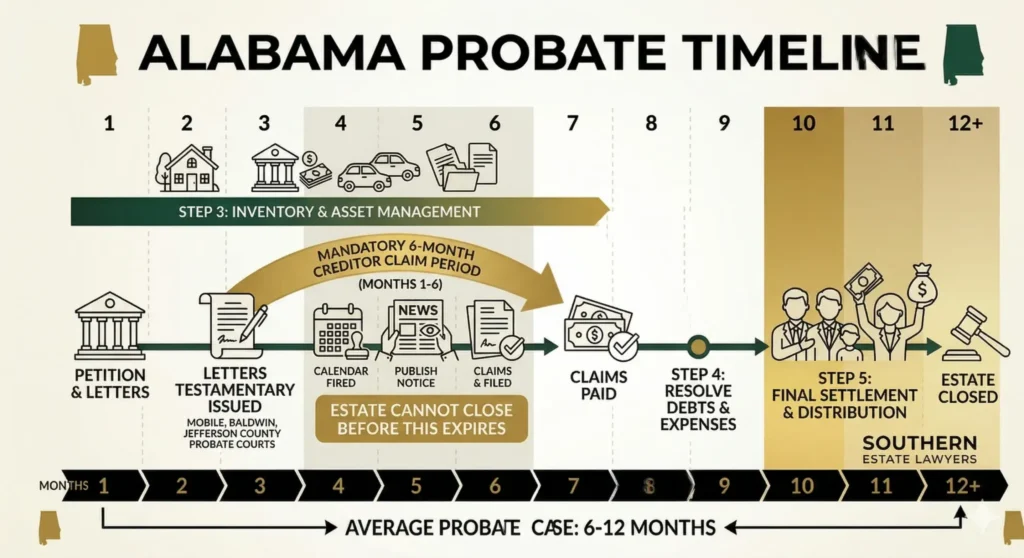
Step 3: Inventory and Asset Management (Ongoing During Months 1–6)
During the creditor period, the personal representative is responsible for gathering and managing the estate’s assets. That usually includes identifying what the deceased owned, obtaining date-of-death values, protecting property from loss, and making sure beneficiaries receive proper notice.
Depending on the estate, those assets may include real estate, bank and retirement accounts, investment accounts, vehicles, business interests, and personal property. If the estate includes real property in counties such as Baldwin or Jefferson, additional filings or steps may be necessary.
Because the executor is acting in a fiduciary role, mistakes in handling estate property or administration can create personal liability.
Step 4: Paying Debts and Expenses
Once the six-month creditor period has ended, the estate can begin resolving its remaining financial obligations. That typically includes paying valid creditor claims, covering funeral expenses, handling court and publication costs, and addressing any attorney’s fees related to the administration.
If the estate does not have enough funds to pay every obligation in full, Alabama law sets the order in which those claims must be paid.
Step 5: Closing Probate in Alabama (Months 7–12)
Once the valid debts have been paid, the creditor period has expired, and the estate’s assets have been fully accounted for, the next step is usually the preparation of a final settlement for the court.
If the heirs are in agreement and the estate is otherwise ready to close, the court may allow a simplified closing process.
Summary Settlement
This speeds up final distribution and allows the estate to close efficiently.
After court approval:
- Remaining assets are distributed
- The Executor is discharged
- The probate case officially ends
For many families, this is the final stage of probate, where the estate is formally wrapped up, and the remaining inheritance can finally be distributed to the beneficiaries.
3 Common Reasons Probate Takes Longer in Alabama
While 6–12 months is typical, certain issues can extend the probate timeline significantly.
1. Will Contests in Alabama
If an heir contests the validity of the will, the Alabama probate process can shift into litigation. In these situations, a will contest lawyer in Alabama is often needed to handle the litigation process.
These disputes often involve allegations of undue influence, claims that the deceased lacked legal capacity, or arguments that the will was not properly executed. When that happens, probate can take much longer. A will contest can easily add another year or two to the timeline, and in some cases, even more.
If you want to see the difference a lawyer can make in these situations, you can review our client victories in estate litigation to see the outcomes we have achieved for Alabama families in contested estate cases.
2. Selling Real Estate During Probate
If the estate includes real property in places such as Mobile, Baldwin County, Birmingham, Hoover, Daphne, or Fairhope, the probate timeline may be affected by how long it takes to deal with that property.
A sale can be delayed by market conditions, the need for court approval, or financing issues on the buyer’s side. For that reason, estates involving real estate often take longer to close.
3. Intestate Estates (No Will)
If a person dies without a will, the estate is treated as intestate. In that situation, Alabama’s intestate succession laws decide who inherits the estate rather than the deceased person’s own written instructions.
That can make the process more involved. The court may require a surety bond, additional proof of heirship, or extra hearings before the estate can move forward, all of which can add time to the Alabama probate process.
★★★★★
“Our four-year-long estate and trust litigation case was resolved in a matter of months when he took over. Excellent job! Would highly recommend him to anyone. Also, the attorneys at his firm are very professional and well organized.” – Brenda L.
Is There a Faster Way? Small Estate Summary Distribution in Alabama
Alabama does provide a simplified process for smaller estates.
If the total value of the estate, not counting homestead property, falls below the statutory threshold, the estate may qualify for a more streamlined procedure instead of full probate administration.
Summary Distribution
Benefits include:
- No full probate administration
- Faster timeline
- Lower court costs
- Reduced attorney fees
This process is significantly faster than traditional probate.
Note: This threshold is adjusted annually for inflation ($36,030 for 2024 and approximately $47,000 for 2025).
Advice From our Alabama Probate Attorneys on Moving Through Probate More Efficiently
Once probate has already begun, the cases that move more smoothly are usually the ones where families stay organized and proactive from the start. In our experience, that often means gathering key documents early (like the will, death certificate, account statements, and property records), keeping all heirs informed about what is happening, and responding promptly to court notices or requests from the personal representative.
Involving a probate lawyer early is one of the most effective ways to speed up probate. The best time to speak with a lawyer is early in the process, often right when probate is first opened or even before it begins. This can make a significant difference in how smoothly the estate moves forward, helping ensure filings are handled correctly, deadlines are met, and avoidable delays or disputes are reduced before they develop.
How a Probate Lawyer at Southern Estate Lawyers Can Help
Our probate attorneys in Alabama represent Executors, Personal Representatives, heirs, and families in how estate administration is handled from start to finish. Our experience in both probate administration and probate litigation allows us to move estates forward correctly while helping reduce delays, prevent disputes, and protect the estate during each stage of the process.
We assist clients with:
- Opening probate estates
- Guiding Executors through required duties
- Filing probate documents and meeting court deadlines
- Addressing creditor claims and estate obligations
- Distributing estate assets to beneficiaries
- Completing the final settlement and closing the estate
While probate laws are state-wide, each county court has its own procedures and timelines. At Southern Estate Lawyers, we can help you move through the Alabama probate process with clarity and confidence.
Get Local Probate Guidance Near You in Alabama
Your family deserves clear guidance during the Alabama probate process. We help protect what matters most and provide support at every step. Clients are served throughout Alabama, including Mobile County, Baldwin County, Jefferson County, Shelby County, and surrounding areas. In-person consultations are available at our office locations:
- Foley: Visit our Foley Office at 218 North Alston Street, Foley, AL 36535. We assist families throughout Baldwin County with probate filings, creditor notices, and estate administration.
- Mobile: Our Mobile Probate Attorneys are located at 6001 Airport Boulevard, Suite 200A, Mobile, AL 36608. We help clients across Mobile and the Gulf Coast navigate the Mobile County Probate Court efficiently.
- Birmingham: Our Birmingham Office is located at 4505 Pine Tree Cir #121, Birmingham, AL 35243, serving Jefferson County and Central Alabama with probate administration and estate guidance.
Can’t make it to one of our offices? We offer virtual consultations for families living out-of-state who need to probate an Alabama estate.
Frequently Asked Questions
If you still have questions on how probate works in Alabama, read answers to common queries we get from clients below. Otherwise, contact our law firm today for personalized assistance.
How long does an executor have to settle an estate in Alabama?
There is no single hard deadline for closing an estate beyond the required six-month creditor period, but most probate matters in Alabama are typically completed within six to twelve months if no major complications arise.
Do I need a probate lawyer in Alabama?
Yes, you can do probate without a lawyer in Alabama, but legal guidance is often helpful. Probate involves court filings, creditor notices, deadlines, and asset distribution, and mistakes in any of those areas can create delays or even personal liability for the executor.
How much does probate cost in Alabama?
The cost of probate depends on the size and complexity of the estate. Common expenses may include court filing fees, publication costs for creditor notice, attorney’s fees, appraisal fees, and bond premiums if a bond is required. Some estates are relatively straightforward, while others involve additional expenses because of real estate, disputes, or more extensive administration.
What happens if someone dies without a will in Alabama?
If someone dies without a will in Alabama, the estate passes according to the state’s intestate succession laws. That means Alabama law decides who inherits. In many cases, intestate estates require more documentation, additional verification of heirs, and sometimes extra court involvement, which can make the process take longer.
Can probate be avoided in Alabama?
In some situations, yes. Probate can often be avoided or reduced through planning tools such as revocable living trusts, beneficiary designations, joint ownership arrangements, and transfer-on-death accounts. The right estate plan can make it much easier for assets to pass without the delays and costs of full probate.